INTERNATIONAL ARTS MAGAZINE
READ THE CURRENT ISSUE
ISSUE FEATURES
ARTISTS

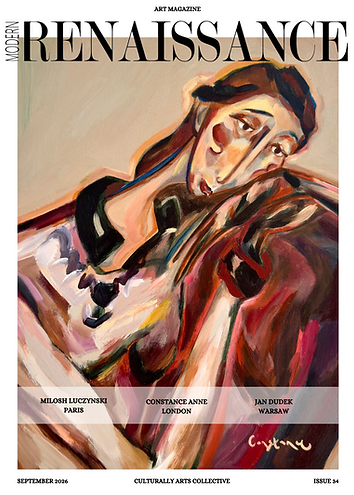
On the Cover:
Constance Anne
I find that having a strong almost geometric and specific structure combined with expressive in the moment marks, can allow for me to manipulate the perspectives and features of a face to bring out a completely different personality.
Fall issue
INDUSTRY

Milosh Luczynski
Where should we look for such a visual code in the post-media era?Contemporary artistic practice increasingly moves between media, disciplines, and systems of knowledge. The boundaries between visual art, technology, performance, science, and popular culture have become increasingly porous.
Fall issue
TRENDING NEWS

Artist to Watch:
Vladimir Semenskiy
Semenskiy paints large-scale canvases built from spontaneous bodily movement, an intimate and eccentric language he calls his own brand of expressionism. Craftsmanship, he insists, exists only to be forgotten: in the act of painting, rational control gives way, and the artist's personal "I" dissolves into pure making. His work has been recognized internationally, including the Brygger J.C. Jacobsen's Portrait Award in Denmark, with his oeuvre culminating most recently in the 2023 solo exhibition AGE OF WISDOM at In-Gate Gallery in Brussels.

Artist Feature:
Dina Bukva
"In my paintings I try to return to those moments. It's something I've always done when I felt alone with my own mind. Through my work, I imagine adult friendships carrying that same sense of ease and quiet presence. More than telling a story, I hope my paintings remind people that some of our deepest connections are formed not through extraordinary moments, but through simply being together."

Artist Feature:
Kseniya Lokteva
"A few years ago, I realized I didn't like being too literal in my paintings. Academic realism isn't the only true objective reality. In fact, no matter how much we'd like to have clear anchors and reference points, our world lacks the concept of objectivity and a “single truth”. Therefore, this hasn't become my aspiration, and I don't seek clarity in my artworks. Later, I realized that the space in which the object exists is no less important, perhaps even paramount."
ARTISTS TO WATCH
ARTIST

Joanna Mora
Costa Rica
ARTIST
Brandon Noel
Florida

ART
Alex Jin
New York
ART

Nikita Croco
Moscow

SUBMIT YOUR ART TO THE NEXT ISSUE

Purchase the
Fall 2026 Issue
Modern Renaissance Magazine
A premiere international arts magazine
Issue length: 114 pages in heavyweight glossy stock
As a 501(c)(3) nonprofit, your purchase of this issue benefits our upcoming exhibition featuring college artists, giving them free submissions, a sales platform, and the credit they need to launch their work. Thank you for supporting our work in arts advocacy.
How do we do in the moments when nothing happens? We fill them with plans, news, and everyday routine. In the pause between events, a person engages themselves. The artists in this issue discover that emptiness is not an absence, but a space open to allowing something new to enter.
Dina Bukva captures the spontaneous afternoons of childhood friendship, a time when closeness grows naturally, simply because no one was in a hurry. Jan Dudek leaves the canvas unfinished so that the past retains the same uncertainty as memory. Kseniya Lokteva allows facial features to dissolve into brushstrokes, preferring the quiet detachment of a half‑empty space. In each case, the canvas becomes a sanctuary for what everyday life tends to miss.
Before the artist says anything, the artwork already speaks for itself. A crack in the porcelain, a stain of paint that defies the intended design: the physical nature of the material is not a shell for the idea, but the idea itself. For NASKA, materiality is combined with the philosophy of kintsugi: the golden cracks on porcelain apples are not a flaw in the form, but its most honest state. Jane Birchall works literally with the hands of several generations, weaving Gozitan lace into ceramics, so that the texture of the clay meets the texture of memory.
Vladimir Semenskiy describes a process in which the artist’s personal “self” must disappear before pure creation begins. Wisdom, according to him, is the right to emptiness. He also formulates a paradox the classical academic school, from which he eventually left, turned out to be precisely the foundation that today ensures his autonomy; mastery, in his words, exists only to be forgotten in the end. Whereas Kseniya Lokteva believes the knowledge she gained at the Academy, which she calls freedom from ignorance, allows her not to think about technique at all and to move directly towards the atmosphere and essence.
There are artists whose craft begins with hands instead of canvas, hands that held a brush or a needle long before them. What seems like a personal choice of style, upon closer examination, turns out to be a family legacy adopted, reinterpreted, or rediscovered for the first time. NASKA grew up in a family of artists, but emigration and motherhood made her speak in her own voice for the first time; her series ‘Fragile World’ is evidence of rebuilding herself anew. She deliberately works in series because, as she admits, the mind works more actively precisely when there are boundaries that cannot be crossed.
ISSUE PARTNERS